Why Megadungeons Succeed or Fail: Lessons from Forty Years of Play
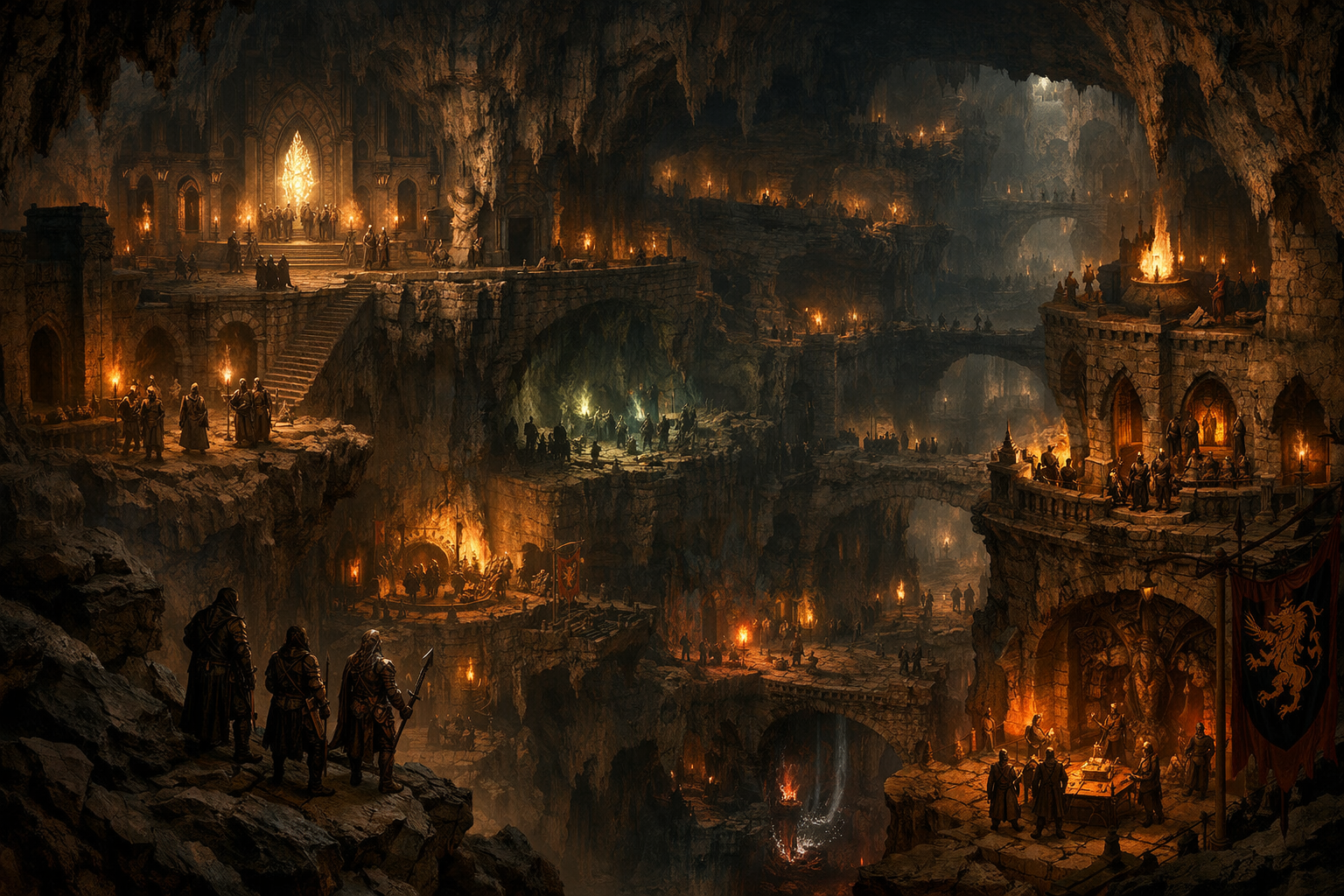
Megadungeons have persisted since the earliest days of tabletop roleplaying, yet many campaigns abandon them within a few sessions. Learn what structural, pacing, and preparation factors separate sustainable megadungeons from those that collapse, and how to apply those lessons at your own table.
Megadungeons have been part of tabletop roleplaying since the 1970s. Gary Gygax and Dave Arneson created Castle Greyhawk and Blackmoor as sprawling, multi-level underworlds that groups explored over months and years (Peterson, 2024). These structures remain popular today, but many campaigns that begin with ambitious megadungeon plans stall or collapse within a handful of sessions. Understanding why some megadungeons sustain play while others fail helps Game Masters design and run these complex environments more effectively.
This article examines the structural, pacing, and preparation factors that determine whether a megadungeon campaign thrives or falters. It draws on published design advice, historical examples, and common pitfalls observed across decades of play. By the end you will have a clearer sense of what to prioritize when building or running a megadungeon, and what warning signs to watch for at your table.
Structural Factors That Make or Break Megadungeons
Lack of Navigational Clarity
One of the most common reasons megadungeons fail is that players lose their sense of orientation and purpose. Unlike a linear adventure or a tightly bounded dungeon, a megadungeon offers dozens or hundreds of rooms across multiple levels. Without clear landmarks, memorable locations, or a mental map of how spaces connect, players feel lost and frustrated.
Gygax and Arneson's original dungeons relied on hand-drawn maps that players created session by session (Gygax & Arneson, 1974). Those maps became a shared reference that helped groups remember where they had been and plan where to go next. Modern megadungeons benefit from similar practices. When players cannot reconstruct their path or distinguish one corridor from another, exploration becomes a chore rather than a discovery.
Game Masters can address this by designing distinctive zones, naming key locations, and encouraging player mapping. A megadungeon with clear visual or thematic shifts between levels (a fungal gallery, a flooded crypt, a scorched armory) gives players mental anchors. Naming rooms or areas (the Hall of Mirrors, the Sleeping Giant's Chamber) makes it easier to discuss plans and recall discoveries.
Insufficient Variety in Encounter Types
A megadungeon that relies solely on combat encounters will exhaust most groups before they reach deeper levels. The structure's longevity depends on varying the types of challenges players face: combat, exploration, social interaction, resource puzzles, environmental hazards, and moments of discovery (Wizards of the Coast, 2014).
When every room contains a monster to fight, players experience mechanical fatigue and narrative monotony. Successful megadungeons intersperse combat with opportunities to negotiate, solve problems, gather information, and make meaningful choices. A faction of goblinoids might trade information for supplies. A trapped library might require careful investigation rather than brute force. A shrine to a forgotten deity might offer a rest and resupply point in exchange for a small offering.
This variety also supports different player types. Some players enjoy tactical combat, others prefer exploration or roleplaying. A megadungeon that offers all three keeps the entire group engaged over the long campaign.
Weak or Absent Factions
Factions give a megadungeon life and continuity. Without them, the dungeon feels like a static collection of rooms and monsters. Factions create relationships, alliances, rivalries, and consequences that extend beyond a single session.
In the original Keep on the Borderlands, the Caves of Chaos housed multiple humanoid tribes with their own territories, leaders, and grudges (Gygax, 1979). Players could exploit those rivalries, form temporary alliances, or watch the dungeon's balance of power shift based on their actions. That dynamism turned a simple dungeon into a small ecosystem.
Modern megadungeons benefit from similar design. When players ally with one faction, they make enemies of another. When they eliminate a powerful group, another moves into the vacated territory. Factions provide narrative continuity and make the dungeon feel like a living place rather than a static puzzle.
No Clear Goal or Exit Conditions
Players need a reason to keep returning to the megadungeon and a sense of what success looks like. Without a goal, the structure becomes an endless grind. Without exit conditions, players never feel they have accomplished anything meaningful.
Some megadungeons use a central mystery: what lies at the deepest level, or who built this place, or what artifact rests in the final vault. Others use a ticking clock: the dungeon is expanding, or a ritual must be stopped, or a kidnapped NPC must be rescued before a deadline. Still others use resource goals: the party needs a specific treasure, information, or ally that can only be found within.
Exit conditions help players know when they are making progress. Clearing a level, defeating a boss, recovering a key artifact, or securing an alliance all mark milestones. These moments give the campaign rhythm and let the group feel a sense of accomplishment before descending further.
Pacing Problems That Derail Megadungeon Campaigns
Grinding Without Narrative Momentum
Pacing is one of the hardest elements to sustain in a megadungeon. Because the structure is designed for long-term play, sessions can start to feel repetitive. Players explore a few rooms, fight some monsters, collect some loot, and leave. If that cycle repeats without variation or escalation, the campaign loses momentum.
Narrative momentum requires rising stakes, new information, and changing circumstances. Perhaps the party's actions on Level One alert the dungeon's deeper inhabitants. Perhaps a faction leader sends emissaries to negotiate or threaten. Perhaps the environment itself begins to change in response to the party's presence. These developments keep the campaign moving forward rather than cycling in place.
Mike Shea recommends tracking the consequences of player actions and introducing complications that force new decisions (Shea, 2023). A megadungeon campaign sustains interest when each session builds on what came before, rather than resetting to a baseline state.
Session Length and Milestone Spacing
A single session in a megadungeon rarely feels complete. Unlike a one-shot or a tightly paced adventure, megadungeon sessions often end mid-exploration. This can frustrate players who prefer a clear beginning, middle, and end to each game night.
Successful megadungeon campaigns manage this by establishing session milestones: clearing a room, defeating a mini-boss, discovering a new level, or finding a safe rest point. These milestones give players a sense of progress even when the larger campaign is far from over.
Justin Alexander discusses pacing in node-based design and dungeon structures, noting that players need regular moments of resolution and decision (Alexander, 2012). A session that ends with a new choice (which corridor to explore next, which faction to approach, whether to retreat or press on) leaves players engaged and planning for the next game.
Resource Attrition and the Death Spiral
Megadungeons often use resource attrition as a core challenge. Players must decide when to rest, when to retreat, and how to manage hit points, spell slots, and consumable items over multiple encounters. However, if attrition becomes too punishing, the campaign enters a death spiral. Players become too weak to continue but feel they cannot afford to leave and lose their progress.
This is a delicate balance. Too little attrition and the megadungeon feels like a series of isolated combats with no cumulative challenge. Too much attrition and players feel trapped in a no-win situation.
Mike Shea suggests establishing safe rest points within the dungeon: hidden shrines, faction encampments, or magically warded rooms where players can recover without returning to the surface (Shea, 2021). These rest points allow for longer delves without the death spiral, and they also serve as narrative anchors and decision points.
Over-Preparation Leading to Rigidity
Some Game Masters prepare megadungeons in exhaustive detail, writing out every room, every encounter, and every NPC before the campaign begins. While thorough preparation can be valuable, it can also make the dungeon feel rigid and unresponsive to player choices.
A megadungeon that unfolds organically, responding to player decisions and table energy, tends to sustain interest better than one that feels like a fixed script. Justin Alexander's node-based design principles apply here: prepare key locations, factions, and conflicts, then let the connections and outcomes emerge through play (Alexander, 2010).
Over-preparation can also lead to frustration when players bypass content the Game Master spent hours creating. A more flexible approach builds the dungeon's deeper levels in response to what players find engaging, rather than committing to every detail in advance.
Preparation Pitfalls That Undermine Megadungeon Play
Ignoring Player Agency and Emergent Story
Megadungeons work best when they support player-driven exploration and decision-making. A megadungeon campaign that railroads the party toward specific outcomes undermines the structure's core appeal.
Players should be able to choose which areas to explore, which factions to engage, and when to retreat. Those choices create the campaign's story. A Game Master who forces specific encounters or punishes players for exploring in the "wrong" order turns the megadungeon into a linear adventure masquerading as open exploration.
Justin Alexander writes about avoiding plot-based preparation in favor of situation-based design (Alexander, 2009). A megadungeon is a situation: a complex environment with factions, resources, and dangers. Players explore that situation and make choices. The story emerges from their decisions, not from a predetermined narrative arc.
Failure to Communicate Expectations at Session Zero
Megadungeons require a different social contract than episodic adventures or sandbox campaigns. Players need to understand that progress will be slow, sessions may end mid-exploration, and the campaign will focus heavily on a single location.
If the group expects variety, rapid character advancement, or narrative closure in every session, the megadungeon format will disappoint them. Session Zero is the time to align expectations, discuss pacing, and confirm that everyone is interested in long-term, location-focused play.
Mike Shea and James Haeck both emphasize the importance of Session Zero for establishing campaign tone, structure, and player buy-in (Shea, 2021; Haeck, 2024). A megadungeon campaign that begins without this alignment often collapses when player expectations clash with the campaign's actual structure.
Neglecting the Surface World and Downtime
A megadungeon campaign is not exclusively about the dungeon itself. Players need a home base, opportunities for downtime, and reasons to care about the world beyond the dungeon's entrance. Without these elements, the campaign feels claustrophobic and disconnected.
The town or settlement near the megadungeon provides opportunities for resupply, rest, social interaction, and narrative development. NPCs in the settlement can offer quests, rumor, or support. Factions in the settlement can interact with factions in the dungeon. Downtime activities (training, research, crafting, carousing) give players a sense of progression and investment.
Ben Robbins' West Marches campaign model, while not a megadungeon itself, demonstrates how a consistent home base and player-driven scheduling can support long-term location-based play (Robbins, 2007). The surface world provides context, contrast, and breathing room.
Lack of Player Buy-In and Investment
Even with strong structure, pacing, and preparation, a megadungeon campaign will fail if players are not invested. Investment comes from connection: to the dungeon's mysteries, to their characters' goals, to the factions they encounter, or to the shared challenge of exploration and survival.
Game Masters can build investment by tying the megadungeon to character backstories, offering meaningful rewards (not just loot, but knowledge, allies, or power), and celebrating player achievements. When the group defeats a major threat, clears a level, or solves a long-standing mystery, that moment deserves recognition.
Investment also comes from shared ownership. When players map the dungeon, name locations, form alliances, and shape the campaign through their choices, they become co-authors of the story. A Game Master who fosters that ownership will have a group eager to return session after session.
Example: The Deepfall Chasm
The Deepfall Chasm is a sinkhole megadungeon beneath a trade city. Its upper levels were once a prison complex, its middle levels a dwarven mining operation, and its deepest levels remain unmapped. The campaign began with strong structural elements: distinctive levels (the Chains, the Ore Halls, the Drowned Vaults), active factions (a thieves' guild, a cult of earth elementalists, remnant prison guards turned raiders), and a central mystery (what caused the collapse that created the Chasm).
By Session Four, however, the campaign was struggling. Players felt they were grinding through rooms without making progress. The Game Master had prepared sixty rooms in exhaustive detail but had not established clear milestones or exit conditions. Players did not know what success looked like or when they could rest.
The Game Master paused the campaign for a mid-course correction. Together with the players, they identified the Chains (the upper prison level) as a short-term goal: clear it, establish a safe camp, and negotiate with one faction. They introduced a ticking clock: the thieves' guild wanted an artifact from the Ore Halls and would pay well, but a rival adventuring party was also searching for it.
These changes gave the campaign immediate focus and long-term structure. Players now had a goal for the next few sessions, a reason to explore deeper levels, and a sense of competition. The megadungeon felt purposeful rather than aimless. By Session Eight, the group had cleared the Chains, formed an uneasy alliance with the thieves' guild, and descended into the Ore Halls with renewed energy.
The key lessons from this recovery were simple: establish milestones, communicate goals, and adjust pacing based on table feedback. The Deepfall Chasm succeeded not because it was perfectly designed from the start, but because the Game Master was willing to adapt and the players were willing to invest.
Practical Recommendations for Sustainable Megadungeons
Based on the factors and pitfalls discussed above, here are practical recommendations for Game Masters planning or running megadungeon campaigns:
- Design clear zones and landmarks. Give each level or region a distinct visual, thematic, or mechanical identity. Name key locations and encourage player mapping.
- Introduce active factions with goals. Factions create continuity, consequences, and dynamic environments. Let players ally with, oppose, or manipulate these groups.
- Establish goals and milestones. Players need to know what they are working toward and when they have made progress. Use short-term and long-term goals to structure the campaign.
- Vary encounter types and challenges. Combat, exploration, social interaction, puzzles, and environmental hazards all have a place in a megadungeon. Mix them to keep the campaign fresh.
- Provide safe rest points. Avoid the death spiral by offering occasional safe havens within the dungeon. These locations also serve as narrative and decision points.
- Hold Session Zero and communicate expectations. Make sure the entire table understands the megadungeon format, its pacing, and its focus on long-term play.
- Develop the surface world and downtime opportunities. A megadungeon campaign needs breathing room. The town, NPCs, and downtime activities provide context and contrast.
- Prepare flexibly and respond to player choices. Over-preparation can make the dungeon feel rigid. Prepare key elements and let the campaign unfold organically.
- Track consequences and escalate stakes. Player actions should have ripple effects. Factions respond, the environment changes, and the dungeon evolves.
- Celebrate achievements and foster player investment. Recognize milestones, tie the dungeon to character goals, and encourage shared ownership of the campaign.
Conclusion
Megadungeons fail when they become aimless grinds, when players lose their sense of purpose and progress, or when preparation becomes rigid and unresponsive. They succeed when they offer clear structure, varied challenges, active factions, meaningful goals, and space for player agency and emergent story.
A sustainable megadungeon campaign is not defined by exhaustive preparation or perfect design. It is defined by adaptability, communication, and a shared commitment between Game Master and players to explore, engage, and invest in the sprawling underworld they create together. Whether you are designing your first megadungeon or trying to revive a stalled campaign, the principles outlined here can help you build something that lasts.
Sources and Further Reading
Alexander, J. (2009, March 23). Don't Prep Plots. The Alexandrian. https://thealexandrian.net/wordpress/4147/roleplaying-games/dont-prep-plots
Alexander, J. (2010, May 27). Node-based scenario design, part 1: The plotted approach. The Alexandrian. https://thealexandrian.net/wordpress/7949/roleplaying-games/node-based-scenario-design-part-1-the-plotted-approach
Alexander, J. (2012, April 6). Game structures, Part 3: Dungeoncrawl. The Alexandrian.
Gygax, G. (1979). B2: The Keep on the Borderlands. TSR.
Gygax, G., & Arneson, D. (1974). Dungeons & Dragons, Volume 3: The Underworld & Wilderness Adventures. Tactical Studies Rules.
Haeck, J. (2024, March 11). How to run a Session 0 for your D&D game. D&D Beyond. Original work published January 8, 2021.
Peterson, J. (2024). The Making of Original Dungeons & Dragons: 1970–1977. Wizards of the Coast.
Robbins, B. (2007, October 17). Grand Experiments: West Marches. Ars Ludi. https://arsludi.lamemage.com/index.php/78/grand-experiments-west-marches/
Shea, M. E. (2021, February 15). Manage Rests. Sly Flourish. https://slyflourish.com/handling_rests.html
Shea, M. E. (2021, April 5). Running session zeros. Sly Flourish. https://slyflourish.com/runningsessionzeros.html
Shea, M. E. (2023). Running Dungeon Crawls. Sly Flourish.
Wizards of the Coast. (2014). Dungeon Master's Guide (5th ed.), Chapters 3, 5, 6, and 8.
Related reading
- Understanding the Megadungeon: What It Is and When to Use It
A megadungeon is more than a big dungeon. Learn what defines this sprawling adventure structure, why it persists across decades of play, and when it serves your table better than episodic adventures.
- Running Sandbox Campaigns: Six Months with The Millbrook Consortium
Sandbox campaigns promise player-driven freedom but demand different preparation and facilitation techniques. This case study examines six months of running The Millbrook Consortium, a merchant-focused sandbox, to identify practical lessons about faction management, player agency, and sustainable open-world play.
- Sandbox vs Railroad: Choosing the Right Campaign Structure for Your Table
Sandbox and railroad campaigns represent fundamentally different approaches to tabletop RPGs. Learn how each structure works, what they offer players and Game Masters, and practical criteria for choosing the approach that fits your table's preferences and play style.