Megadungeon Architecture: Four Design Principles That Support Play Over Preparation
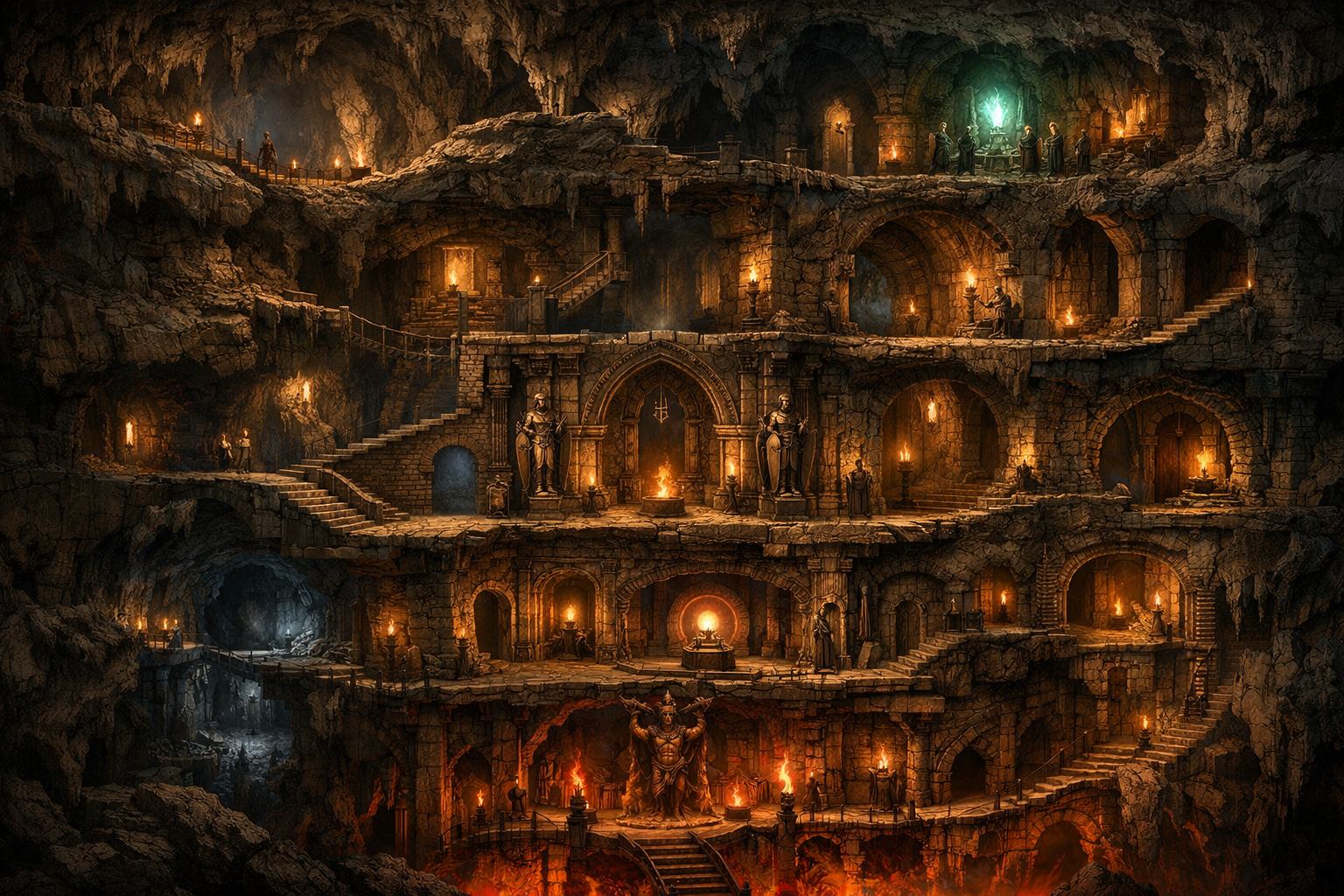
Megadungeons demand architectural thinking, not cartographic perfection. Learn four structural principles that reduce preparation load while preserving player agency and discovery over months of campaign play.
A megadungeon is more than a large map.
Its architecture determines whether hundreds of rooms create meaningful exploration or simply produce more corridors to clear. Because a megadungeon may remain relevant for dozens of sessions, decisions about levels, routes, connections, landmarks, and preparation scale have consequences far beyond a single encounter.
The challenge is not necessarily to draw every corridor before Session 1.
It is to establish enough persistent structure that player choices about movement remain meaningful while allowing the Game Master to add detail at a sustainable pace.
This article presents four practical design principles:
Vertical complexity
Navigational choice
Structural modularity
Sustainable density
These are design tools rather than universal requirements. Different megadungeons may emphasize them in different proportions.
Together, however, they address one of the central challenges of megadungeon design:
How do you build a place large enough to sustain long-term exploration without requiring the Game Master to finish hundreds of rooms before anyone starts playing?
Principle One: Vertical Complexity
Vertical complexity describes how different dungeon levels, elevations, sublevels, and zones relate to one another.
A megadungeon does not need to be a simple staircase descending from Level 1 to Level 2 to Level 3.
Instead, depth can create another dimension of decision-making.
Players might discover:
Stairs descending one level
A shaft dropping two levels
A sloping passage whose elevation is initially unclear
An ancient lift connecting several regions
A sublevel accessible only through one faction's territory
A cavern that intersects multiple constructed levels
The result is a dungeon where going deeper is a choice, not merely the next chapter.
Historical Depth and Difficulty
The association between dungeon depth, danger, and reward has roots in the earliest D&D rules.
The Underworld & Wilderness Adventures (1974) includes procedures that use dungeon level when determining monsters and treasure. The rules contain a Monster Determination and Level of Monster Matrix, while the treasure tables increase potential values and the likelihood of certain treasure types as depth below the surface increases (Gygax & Arneson, 1974).
That created an intuitive relationship:
Greater depth could mean greater risk and greater potential reward.
Modern megadungeons do not need to follow that convention rigidly.
Danger might instead depend on:
Faction territory
Environmental instability
Magical contamination
Alert status
Distance from safe routes
Particular zones rather than numerical level
The useful principle is that moving between major regions should often change something players care about.
Give Zones Distinct Identities
A zone can be summarized with a short premise.
For example:
The Crumbling Galleries: Ancient prison architecture disrupted by later excavation and collapse.
The Ore Halls: Abandoned mining works partially reclaimed by the Ironclad Guild.
The Drowned Vaults: Older structures submerged after subterranean flooding.
That premise helps guide future preparation.
If the Ore Halls are:
Industrial
Unstable
Partly occupied
Rich in abandoned mining infrastructure
then rooms added later can reflect those facts without requiring the entire level to be completed in advance.
The premise becomes a consistency tool.
Use Environmental Transitions
Players should often be able to recognize that they are approaching a different region before a title card announces it.
Useful signals include:
Architecture changing
Temperature rising or falling
New sounds
Different stonework
Water appearing
Faction markings changing
Increased magical effects
Changes in air quality
Different construction materials
For example, approaching the Drowned Vaults might involve:
Water flowing down stairs
Mineral deposits appearing on walls
Rotting wooden supports
Echoing water
Increasing humidity
The environment communicates the transition.
Connect Levels in More Than One Way When Useful
Alternative vertical connections can dramatically increase exploration value.
Suppose the upper dungeon connects to the Ore Halls through:
Main lift: Reliable but controlled by the Ironclad Guild.
Collapsed shaft: Dangerous but avoids Ironclad territory.
Old maintenance stair: Longer and partially unexplored.
Now the question is not merely:
"How do we reach the Ore Halls?"
It becomes:
"Which route best supports what we're trying to accomplish?"
That is meaningful navigation.
Multiple Routes Are a Tool, Not a Requirement
Not every zone needs exactly two entrances and two exits.
Some places should be difficult to reach.
A sealed tomb might intentionally have one known entrance.
A fortress may have one obvious gate.
A collapsed section may create a temporary chokepoint.
The important question is whether the dungeon as a whole gives players enough meaningful route decisions for spatial knowledge to matter.
A single chokepoint is not automatically railroading.
The problem emerges when the Game Master continually negates reasonable alternatives because only one route is allowed to function.
Verticality Can Support Incremental Preparation
Vertical organization can also help control prep scope.
The Game Master might know:
The names of six major regions
Their relative elevations
Which regions connect
Which factions operate there
Their broad themes
Only the region currently being explored needs extensive room-level detail.
For example:
Upper Chasm: Detailed now.
Ore Halls: Partially keyed because players know routes leading there.
Drowned Vaults: Major landmarks established, secondary rooms still light.
Unknown depths: Concept only.
The dungeon has stable large-scale geography without requiring every chamber to exist in finished form.
Principle Two: Navigational Choice
Navigational choice exists when different movement decisions produce different risks, costs, information, or opportunities.
A huge map does not automatically provide meaningful navigation.
Thirty identical corridors are thirty options geometrically, but not necessarily thirty useful decisions.
The players need enough information to distinguish alternatives.
Make Routes Legible
Consider a three-way intersection.
To the left:
Cold air moves through a narrow stone passage marked with Ironclad warning symbols.
Ahead:
A wide stairway descends toward distant hammering.
To the right:
Water flows beneath a cracked iron gate.
The players do not know exactly what lies down each route.
They know enough to reason about them.
That is the goal.
Information can come from:
Architecture
Sounds
Smells
Tracks
Faction symbols
Maps
Rumors
Previous expeditions
Environmental clues
Uncertainty remains.
But it becomes informed uncertainty.
Different Routes Should Sometimes Have Different Costs
One path might require:
Fighting
Negotiating
Equipment
Time
Noise
Magical resources
Accepting faction scrutiny
For example:
Guarded Checkpoint
Fast route.
Requires negotiation with the Ironclad Guild or confrontation with its guards.
Collapsed Passage
Avoids faction territory.
Requires tools and several hours of excavation.
Flooded Tunnel
Potential shortcut.
Requires swimming, magic, or specialized equipment.
None is inherently correct.
Different parties may choose differently.
The same party may choose differently on separate expeditions.
Let Players Change the Route Network
One of the strongest forms of megadungeon progression is changing the dungeon itself.
Players might:
Repair an elevator
Destroy a barricade
Unlock a permanent gate
Drain a flooded tunnel
Secure passage through faction territory
Build a bridge
Discover a secret staircase
Establish a protected camp
These improvements can matter for the rest of the campaign.
Character progression then exists alongside infrastructure progression.
The party becomes more capable because its relationship to the dungeon has changed.
Preserve the Consequences of Geographic Choice
If players deliberately avoid the eastern wing, the major encounter prepared for the eastern wing should not mysteriously relocate west merely because the Game Master wants it used.
That undermines the value of mapping.
Similarly, if players spend resources opening a shortcut, future expeditions should benefit unless something in the fiction changes it.
Persistent geography is one of the defining strengths of megadungeon play.
The dungeon should remember what players did to it.
Use Chokepoints Carefully
Chokepoints are not inherently bad.
They can create:
Strategic conflict
Faction control
Defensive positions
Negotiation opportunities
Valuable shortcuts
A bridge controlled by one faction may become one of the most important locations in the campaign.
Problems arise when every meaningful route collapses into the same unavoidable encounter regardless of what the players attempt.
A good chokepoint creates a problem.
It should not automatically dictate one solution.
Principle Three: Structural Modularity
Structural modularity means dividing a huge environment into manageable components that can be designed and maintained independently while remaining part of persistent geography.
This requires an important distinction:
Modular preparation does not mean interchangeable geography.
Once players know that the Ironclad command post lies beyond the western mine works, that fact should remain dependable.
The Game Master can prepare areas in modules without treating those modules as pieces that teleport wherever the party travels.
What Can Function as a Module?
A module might be:
A shrine complex
A faction headquarters
A collapsed mine section
A prison block
A monster lair
A market enclave
A tomb
A small cave network
The component has enough internal identity that the Game Master can prepare it separately.
It also has known connections to the larger dungeon.
For example:
Abandoned Shrine
Entrance from Ore Hall 14.
Secondary exit into a maintenance tunnel.
Collapsed stairway toward a deeper region.
Those relationships remain fixed.
Modules Reduce Cognitive Load
Instead of thinking:
"I need to design 180 rooms."
the Game Master can think:
"I need to finish the western Ironclad works before the party reaches them."
That region may consist of:
Guard post
Workshop
Storage area
Barracks
Command chamber
Abandoned neighboring tunnels
The Game Master can understand it as one coherent component.
Once complete, attention shifts elsewhere.
Modules Can Have Different Internal Structures
Not every module needs to be designed the same way.
A faction headquarters might emphasize:
Social interaction
Patrol routes
Security
A tomb might emphasize:
Traps
History
Environmental puzzles
A monster lair might emphasize:
Territory
Hunting routes
Escape paths
Varied structures prevent the dungeon from becoming mechanically uniform.
Five Room Dungeons as Inspiration
Johnn Four's Five Room Dungeon framework is a well-known method for creating compact adventures.
The model typically includes:
Entrance and guardian
Puzzle or roleplaying challenge
Trick or setback
Climax or major conflict
Reward, revelation, or twist
The current Roleplaying Tips material republishes a framework that originally appeared in an earlier newsletter issue and was later expanded through the Five Room Dungeon contest (Four, n.d.).
That framework can inspire self-contained sub-sites inside a megadungeon.
For example, a sealed shrine might contain:
A difficult entrance
An interpretive puzzle
A dangerous reversal
A major encounter
A revelation
But not every megadungeon region should follow that sequence.
Megadungeons usually benefit from less predictable structures and more route choice than a compact five-part adventure typically assumes.
Use the model as inspiration for concentrated content, not as a universal architectural template.
Reuse Patterns, Not Locations
If one faction outpost works well, you can reuse the underlying design pattern elsewhere.
For example:
Outpost pattern
Controlled entrance
Common area
Supply room
Leadership space
Escape route
A different faction can use that structure differently.
What should not happen is moving the exact same established outpost into whatever route the party chooses.
Reusable design grammar is valuable.
Quantum geography is not.
Keep Modules Connected
Modularity should not make the dungeon feel like disconnected mini-adventures.
Relationships should cross boundaries.
Perhaps:
Ironclad miners trade with another enclave.
Deeplight cultists steal equipment from Ironclad workshops.
Hollowborn avoid one ancient shrine.
Water from the Drowned Vaults is beginning to flood a lower mining tunnel.
Players who understand those relationships gain useful knowledge.
Modules remain locally manageable while the dungeon remains globally interconnected.
Record What Becomes True
If part of a lightly prepared module is improvised during play, record it.
For example:
Ore Hall W-7: Old pump station. Rusted machinery. Deeplight graffiti on east wall. Secret maintenance hatch discovered by Mira. Connects to W-9.
That is now dungeon geography.
Future sessions should respect it.
This is how incremental preparation gradually becomes a persistent world.
Principle Four: Sustainable Density
Sustainable density means concentrating preparation effort where additional detail produces useful play.
A megadungeon contains more potential space than most Game Masters can prepare at maximum detail.
The answer is not necessarily to make the dungeon smaller.
It is to vary how much preparation each location receives.
Not Every Room Needs Equal Detail
Compare two locations.
Storage Chamber
Contains:
Broken barrels
Mining tools
Ironclad supply marks
Scratched warning about flooding
That might be enough.
Hollowborn Archive
Contains:
Named NPC
Historical revelation
Unusual architecture
Negotiation opportunity
Valuable map
Multiple exits
That location deserves more preparation.
Equal word count does not create equal quality.
Prepare according to function.
Historical Empty-Space Procedures
The 1979 Dungeon Masters Guide random dungeon tables are useful historical evidence for how early dungeon procedures treated room density.
Its Chamber or Room Contents table produced:
60% Empty
10% Monster only
15% Monster and treasure
5% Special
5% Trick/trap
5% Treasure
That does not mean a modern megadungeon should be exactly 60 percent empty.
The table belongs to a particular style of play and particular procedural assumptions.
What it does demonstrate is that historically, a dungeon room did not need a major encounter to justify existing.
Empty and low-density spaces can serve important purposes.
What "Empty" Can Mean
An empty room does not need to contain literally nothing.
It may contain no immediate encounter while still providing:
Architecture
Evidence
Graffiti
Old furniture
Remains
Environmental clues
A landmark
A resource
A route
Foreshadowing
For example:
An abandoned guardroom. Six rusted weapon racks. The southern wall bears three fresh chalk marks matching Ironclad survey notation.
There may be no monster, trap, or treasure.
The room still communicates information.
Empty Does Not Mean Safe
A currently unoccupied chamber might still be:
Inside hostile territory
Exposed to patrols
Structurally unstable
Easily discovered
Dangerous to rest in
Whether characters can safely remain there depends on campaign procedures and fictional circumstances.
Do not equate an empty stocking result with a safe rest location.
Use Detail Tiers
Instead of assigning a universal percentage of "important rooms," use tiers.
Tier One: Landmark Locations
High preparation.
Examples:
Faction leader's chamber
Major shrine
Unique magical site
Critical junction
Significant treasure location
Tier Two: Functional Locations
Moderate preparation.
Examples:
Barracks
Workshop
Guard station
Library
Mine office
A few concrete details and inhabitants may be sufficient.
Tier Three: Transitional Locations
Light preparation.
Examples:
Corridors
Empty storage
Minor chambers
Unused cells
Connecting caves
These locations need enough identity to preserve geography and atmosphere.
This approach lets the Game Master control workload without pretending every room deserves equal design time.
Density Should Follow the Zone
Different regions can have different densities.
An occupied faction headquarters may contain frequent interaction.
An abandoned ruin may have long stretches of silence.
A monster-infested cavern system may contain fewer constructed landmarks but more environmental hazards.
The variation itself helps regions feel distinct.
Do Not Optimize Every Room for Speed
The goal of low-density rooms is not simply to move players through them as quickly as possible.
Sometimes players become fascinated by a minor location.
That is fine.
A scratch on the wall might become important because players connect it to something discovered earlier.
Follow interesting play.
Sustainable density concerns preparation effort, not imposing a maximum amount of table time on locations the GM originally considered unimportant.
Focused Preparation
Mike Shea's dungeon-preparation guidance provides a useful complementary approach.
His Prepping a Dungeon method emphasizes practical elements such as:
A clear goal or starting point
A usable map
Brief chamber descriptions
Inhabitants
Traps or hazards
Treasure
Secrets and clues
The broader lesson is not "prepare nothing and improvise everything."
It is:
Prepare the information that helps you run the location confidently, without assuming every possible detail needs to be written beforehand.
That principle scales particularly well to megadungeons.
Combining the Four Principles
These principles reinforce one another.
Vertical complexity defines relationships among major depths and zones.
Navigational choice turns those relationships into player decisions.
Structural modularity lets the Game Master prepare large spaces in manageable components.
Sustainable density determines how much preparation each component actually needs.
Together they can produce a megadungeon whose large-scale structure is stable while its fine detail grows alongside play.
Example Workflow
Imagine preparing a new dungeon region.
Step 1: Establish Its Place Vertically
The Ore Halls lie below the upper prison structures and above the Drowned Vaults.
Step 2: Establish Connections
The Ore Halls connect upward through:
Main Ironclad lift
Collapsed maintenance shaft
They connect downward through:
Flooded stairway
Broken industrial elevator
Step 3: Divide the Region Into Modules
The Ore Halls contain:
Active Ironclad works
Abandoned western galleries
Deeplight-contested tunnels
Old processing complex
Step 4: Assign Detail
The Ironclad command post receives extensive preparation.
A major abandoned pump station gets moderate preparation.
Most minor galleries receive brief notes.
Now the dungeon has architecture without requiring every room to be equally developed.
You Do Not Need Every Principle Everywhere
A megadungeon can intentionally break these patterns.
A tomb may have one entrance.
A labyrinth may be deliberately disorienting.
A sacred level may contain almost no inhabitants.
A collapsed zone may have few navigational choices.
Those exceptions become more meaningful when the larger dungeon establishes different expectations.
The principles are tools.
Use them when they improve play.
Measuring Architectural Quality
The quality of a megadungeon is difficult to determine from the map alone.
The stronger questions emerge during play.
Do Players Form Route Preferences?
Do they say:
"Let's use the western shaft. It avoids Deeplight patrols."
If so, geography is producing decisions.
Does Knowledge Improve Performance?
Do players remember:
Shortcuts
Safe contacts
Dangerous regions
Faction borders
Environmental hazards
If so, exploration is producing mastery.
Do Player Actions Change Future Navigation?
Can they:
Open shortcuts
Destroy bridges
Repair lifts
Negotiate access
Secure routes
If so, architecture is participating in campaign progression.
Is Preparation Staying Manageable?
Can the Game Master prepare the likely next areas without constantly finishing enormous sections nobody may visit?
If so, the architecture supports incremental preparation.
There is no universal time target.
One GM may happily spend several hours preparing a level.
Another may have thirty minutes.
Sustainable architecture is architecture compatible with the preparation time your campaign can realistically support.
Example: Deepfall Chasm
The Deepfall Chasm is the recurring fictional megadungeon used throughout this series.
Its established geography includes:
The Crumbling Galleries and Chains in the upper reaches
The Ore Halls below
The deeper Drowned Vaults
Ironclad Guild territory
Hollowborn activity
Deeplight cult operations
Additional unexplored depths
The four architectural principles can organize that existing material without rewriting the dungeon's continuity.
Vertical Complexity
The upper Chasm contains the Crumbling Galleries and portions of the Chains, where ancient prison structures intersect later excavation and collapse.
Below lie the Ore Halls, a large network of abandoned and partially reclaimed mining works.
Farther down are the Drowned Vaults, older structures damaged and partially submerged by underground water.
Beyond those regions lie depths that remain only partially understood.
Each transition changes:
Architecture
Environmental conditions
Dominant inhabitants
Available resources
Types of risk
Players can recognize that descending means entering a different situation, not simply another floor with larger numbers.
Navigational Choice
Several major routes connect the known regions.
The Ore Halls can be reached through:
Ironclad lift
Reliable and relatively fast, but controlled by the Ironclad Guild.
Maintenance shaft
Partially collapsed and difficult to traverse, but avoids the primary Ironclad checkpoint.
The Drowned Vaults can eventually be reached through:
Flooded stair
Known route requiring preparation for deep water.
Broken industrial lift
Potentially faster if repaired.
Those options create strategic decisions.
A party friendly with the Ironclad Guild experiences the map differently from a party that has made them enemies.
Structural Modularity
The Game Master can divide each region into manageable components.
Crumbling Galleries
Abandoned prison wing
Scavenger territory
Collapsed excavation
Ironclad approach
Ore Halls
Active Ironclad works
Abandoned mine network
Deeplight-contested tunnels
Processing complex
Drowned Vaults
Flooded archive
Hollowborn sanctuary
Submerged ceremonial chambers
Ancient lift complex
Each component has fixed geography and known major connections.
The Game Master can prepare them separately as the party approaches.
Sustainable Density
Not every location needs equal preparation.
In the Ore Halls:
Ironclad Command Post
High detail because it contains recurring NPCs, political decisions, and strategic access.
Old Pump Station
Moderate detail because its machinery could alter flooding elsewhere.
Abandoned Storage Gallery
Light detail: damaged carts, empty bins, Ironclad survey markings, one unexplored maintenance hatch.
All three locations contribute.
They simply require different amounts of preparation.
Persistent Change
Suppose the players repair the industrial lift between the Ore Halls and Drowned Vaults.
That change remains.
Future expeditions gain a faster route.
Ironclad leaders may want access.
Deeplight cultists may try to sabotage it.
Hollowborn inhabitants may react to increased surface traffic.
One architectural decision creates several campaign consequences.
That is exactly what megadungeon architecture should enable.
Common Architectural Mistakes
Designing One Required Route
Linear sections are fine.
An entire megadungeon where every meaningful expedition follows the same route wastes much of the potential of persistent geography.
Add loops, secondary connections, shortcuts, or optional branches where they improve player decision-making.
Moving Content to Force Encounters
Do not undermine geographic choice by secretly moving established content.
If players avoided a location, that choice should generally remain meaningful.
Reuse unused ideas in genuinely undefined material when appropriate.
Do not invalidate known geography.
Making Every Zone Equally Dense
Different spaces should breathe differently.
An occupied fortress and an abandoned catacomb should not necessarily contain the same encounter frequency.
Let density reinforce identity.
Detailing Too Far Ahead
The deeper an area is beyond current player interest, the less room-level detail it usually needs.
Establish concepts and connections first.
Expand when the party moves toward it.
Treating Modularity as Disconnection
Modules should remain part of one dungeon.
Connect them through:
Factions
Resources
History
Environmental systems
Routes
Consequences
Players should gradually perceive how the pieces affect one another.
Practical Architecture Checklist
When designing a new megadungeon region, ask:
Vertical Relationship
What lies above it?
What lies below it?
How can characters move between them?
What visibly changes at the boundary?
Navigation
What meaningful route choices exist?
What information distinguishes them?
Can players create new routes?
Which chokepoints matter?
Modularity
What are the major subareas?
Which require detailed preparation now?
Which can remain lightly sketched?
Are their locations and connections stable?
Density
Which locations deserve significant preparation?
Which rooms mainly provide geography or context?
Does encounter density fit the region's fictional state?
Is the amount of preparation sustainable?
If those questions have useful answers, the architecture is probably doing meaningful work.
Final Principle
The purpose of megadungeon architecture is not to produce the most elaborate map.
It is to create a persistent decision space.
Players should gradually understand:
Where they are
What lies nearby
Which routes they trust
Which areas they fear
Which factions control access
Which obstacles they can eventually overcome
How their previous actions changed future expeditions
The Game Master does not need to know every chair, corridor, and storeroom before the campaign begins.
But the facts players discover should remain dependable.
That balance is central to sustainable megadungeon design:
Fix what needs to be persistent. Leave room to elaborate what has not yet mattered.
Vertical complexity creates depth.
Navigational choice creates agency.
Structural modularity makes large-scale preparation manageable.
Sustainable density directs effort toward the places where additional detail will actually improve play.
Together, those principles allow a megadungeon to grow with the campaign without becoming arbitrary.
The dungeon can remain larger than the Game Master's current notes while still feeling like a place that existed before the characters entered it.
That is the architectural foundation long-term exploration needs.
Sources and Further Reading
Alexander, J. (2010, May 27). Node-based scenario design, part 1: The plotted approach. The Alexandrian. https://thealexandrian.net/wordpress/7949/roleplaying-games/node-based-scenario-design-part-1-the-plotted-approach
Alexander, J. (2010, August 18). Jaquaying the dungeon: Addendum, dungeon level connections. The Alexandrian.
Alexander, J. (2012, April 6). Game structures, part 3: Dungeoncrawl. The Alexandrian.
Four, J. (n.d.). 5 room dungeons + contest. Roleplaying Tips. https://www.roleplayingtips.com/rptn/5-room-dungeons-contest/
Gygax, G. (1979). Dungeon masters guide. TSR.
Gygax, G., & Arneson, D. (1974). Dungeons & Dragons, volume 3: The underworld & wilderness adventures. Tactical Studies Rules.
Shea, M. E. (2018). Return of the lazy dungeon master. Sly Flourish.
Shea, M. E. (2023, November 27). Prepping a dungeon. Sly Flourish. https://slyflourish.com/preppingadungeon.html
Related reading
- Stocking Your Megadungeon: Four Methods That Support Long-Term Play
A megadungeon needs inhabitants, treasure, and surprises that sustain dozens of sessions. Learn four practical stocking methods, from random tables to thematic layering, and apply them to your own ongoing campaign.
- Why Megadungeons Succeed or Fail: Lessons from Forty Years of Play
Megadungeons have persisted since the earliest days of tabletop roleplaying, yet many campaigns abandon them within a few sessions. Learn what structural, pacing, and preparation factors separate sustainable megadungeons from those that collapse, and how to apply those lessons at your own table.
- Understanding the Megadungeon: What It Is and When to Use It
A megadungeon is more than a big dungeon. Learn what defines this sprawling adventure structure, why it persists across decades of play, and when it serves your table better than episodic adventures.