Five Weeks in the Sunken Archive: Lessons from a Real Dungeon Crawl Campaign
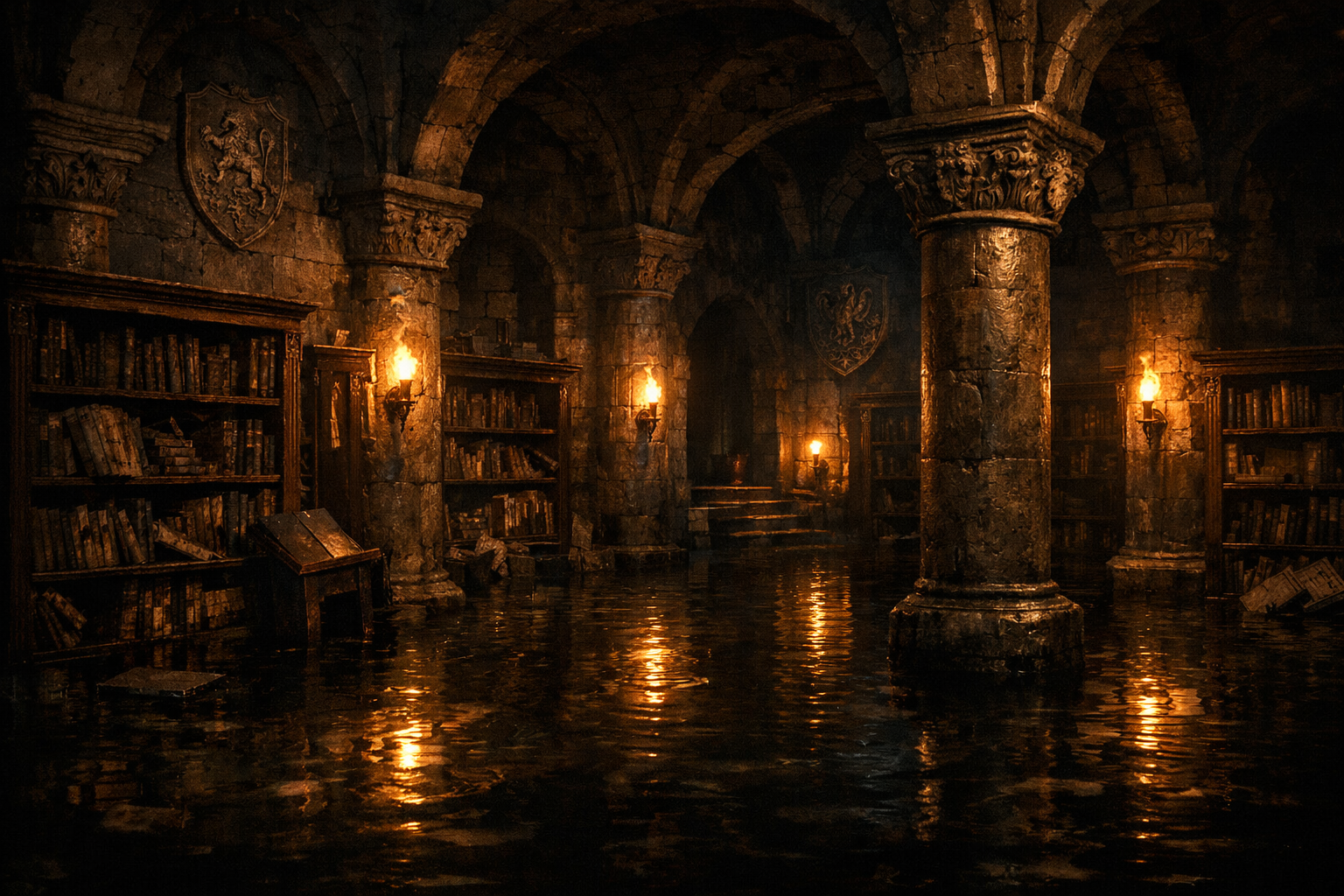
A five-session dungeon crawl through a flooded library taught valuable lessons about pacing, player agency, and adaptive design. Discover what worked, what failed, and how these insights can improve your own adventures.
Dungeon design changes the moment players enter the map.
The route you expected them to take may be ignored.
A puzzle you considered simple may dominate an entire session.
A carefully balanced monster may interact with the party in a way your calculations never predicted.
A room you barely developed may become the group's favorite location.
And the players may solve your biggest problem using a feature you originally considered background scenery.
That gap between prepared dungeon and played dungeon is one of the most useful places a Dungeon Master can learn.
This article uses the Sunken Archive, a fictional composite dungeon-crawl case study, to examine that gap.
The Sunken Archive and the five-session sequence described here are not a documented actual-play campaign. They combine common dungeon-design situations into one consistent example so we can examine:
- Unexpected routes
- Environmental pressure
- Puzzle pacing
- Encounter-design mistakes
- Player-created solutions
- Post-session reflection
The goal is not to present an ideal dungeon.
It is to show how a Dungeon Master can examine what was expected, what actually occurred, and what should change next time.
The Sunken Archive
The premise is straightforward.
An ancient underground library was built partly into natural caverns.
Centuries later, changing underground waterways flooded much of the lower complex.
The upper archive remains mostly dry but structurally unstable.
The lower levels contain anywhere from shallow standing water to completely submerged passages.
The archive still holds:
- Historical records
- Magical research
- Sealed collections
- Forgotten artifacts
But it is no longer empty.
Flood damage awakened or damaged old constructs.
Aquatic creatures entered through natural waterways.
Some magical defenses continue operating without anyone left to maintain them.
The Dungeon Master's initial map contains twenty-three keyed areas across three interconnected levels.
That does not mean the party is expected to visit all twenty-three.
The map includes:
- Several possible combat situations
- Environmental hazards
- Mechanical systems
- Sealed collections
- A few intelligent inhabitants
- Multiple routes between levels
- An entrance hall
- A drainage system
- A central flooded chamber
- An upper archive
- A sealed master collection
The initial expectation is that the dungeon will probably occupy several sessions.
That estimate is deliberately loose.
Dungeon pacing belongs partly to the players.
The Party
For this composite example, the party contains four characters:
- Ranger
- Cleric
- Wizard
- Rogue
The important preparation question is not what stereotypes those classes suggest.
It is what these particular players enjoy.
Assume the group has already indicated that it enjoys:
- Tactical problems
- Exploration
- Environmental manipulation
- Discovering how locations work
They enjoy social interaction too, but do not want every dungeon session dominated by extended negotiations.
That information influences preparation.
It does not determine what the players must do.
Before Session One: What the Dungeon Master Assumes
The Dungeon Master expects the party to enter through the archive's formal entrance.
That entrance contains:
- Carved pillars
- Signs of structural damage
- Evidence of flooding farther below
- A small defensive mechanism
- Several possible directions inside
The expectation is reasonable.
It is also wrong.
That becomes Lesson One.
Lesson One: Players Explore Places, Not Your Intended Route
Within the first portion of the session, the Ranger asks:
"If the lower levels flooded from underground water, would there be some kind of drainage outlet outside?"
The Dungeon Master did not specifically prepare an exterior drainage entrance.
But the question makes sense.
The archive has:
- Flood-control architecture
- Lower chambers
- Water-management mechanisms
A drainage system is consistent with the location.
After considering the terrain and established architecture, the Dungeon Master decides that an old drainage channel does exit farther down the hillside.
The party investigates.
They find it.
Instead of entering the archive through Level One, they crawl through the drainage system and emerge on Level Two.
Several prepared rooms have just been bypassed.
Nothing has gone wrong.
What the Original Preparation Got Wrong
The map itself is fine.
The mistake was mentally converting:
"This is the obvious entrance."
into:
"This is where the adventure begins."
Those are not the same statement.
The players understood something about the dungeon's physical logic and used it.
That is successful exploration.
Prepare the Location, Not the Route
Justin Alexander's situation-based preparation provides a useful model here.
Instead of preparing:
- Characters enter front door.
- Characters encounter the entrance defense.
- Characters descend to Level Two.
- Characters discover the flooding.
- Characters reach the archive chamber.
prepare:
- What the archive contains
- How its levels connect
- What controls the water
- Who occupies each area
- What information exists
- What changes when areas are disturbed
Now the Dungeon Master can run the same location from another direction.
The rooms still exist.
The enemies still have goals.
The archive still has history.
Only the party's route changed.
What Happens to the Bypassed Material?
Leave it where it is.
Do not secretly relocate the entrance encounter to the drainage passage because you already prepared it.
The party earned a different route.
The upper level may still matter later.
Perhaps it contains:
- Another route
- Useful records
- Supplies
- An inhabitant
- The key to a sealed area
If the players eventually visit it, the preparation remains useful.
If they never do, that is also acceptable.
Unused preparation is not automatically wasted preparation.
Postmortem Entry
After the session, record:
Expected: Front entrance, Level One first.
Actual: Party inferred drainage architecture and entered through Level Two.
Why it worked: The dungeon's physical logic supported their idea.
Preparation weakness: Too much mental attachment to a likely sequence.
Change for future prep: Review important locations from more than one plausible approach and understand how rooms function independently of arrival direction.
That is more useful than writing:
"Players ruined the planned entrance."
They did not.
They explored.
Lesson Two: Environmental Pressure Should Follow Rules the Players Can Understand
The flooded sections of the Sunken Archive are meant to make the environment matter.
That is a good goal.
But the original draft made a common mistake by inventing broad effects such as:
- Waist-deep water automatically reducing Speed
- Stealth becoming nearly impossible
- Repeated generic Constitution checks merely for being in cold water
Those are not universal current D&D rules.
Environmental pressure works better when the Dungeon Master knows exactly what rule or location-specific effect is being applied.
Current Swimming Rules
Under the current rules, while a creature is swimming, each foot of movement costs 1 extra foot unless the creature is using a Swim Speed.
In rough water, the DM can optionally require a DC 15 Strength (Athletics) check to move.
That is different from declaring that every flooded floor automatically uses the swimming rules.
Characters wading through knee-deep or waist-deep water might instead encounter:
- Difficult Terrain
- Concealed footing
- Environmental hazards
- Location-specific complications
if those effects fit the situation.
Make that clear.
Frigid Water Has Specific Rules
Current D&D also has a specific rule for frigid water.
A creature can remain immersed for a number of minutes equal to its Constitution score without ill effect.
After that, each additional minute requires a DC 10 Constitution saving throw.
On a failure, the creature gains 1 Exhaustion level.
Creatures with Resistance or Immunity to Cold damage automatically succeed, as do creatures naturally adapted to ice-cold water.
That creates legitimate pressure.
But not every flooded dungeon needs to contain frigid water.
Decide what the environment actually is.
The Sunken Archive's Environmental Rules
For this version of the dungeon, the Dungeon Master establishes several specific facts.
Shallow Flooding
Some areas contain only ankle- or knee-deep water.
No special rule is automatically required.
It may still:
- Reveal tracks
- Extinguish dropped flames
- Conceal small objects
- Carry sound
- React to electricity or magic when a specific effect says so
Deep Flooding
Some passages require actual swimming.
Use the normal swimming rules.
Rough Current
A damaged flood-control chamber contains fast-moving water.
Here, the optional Athletics rule for rough water becomes relevant.
Frigid Lower Reservoir
One underground reservoir is explicitly fed by an extremely cold subterranean source.
Use the frigid-water hazard there.
The players now have information they can plan around.
Why Explicit Environmental Rules Improve Agency
If players know:
"That lower reservoir is dangerously cold."
they can consider:
- Protection from cold
- Shorter exposure
- Ropes
- Alternate routes
- Magic
- Equipment
- Retreat
If the DM instead begins requesting Constitution saves whenever the water feels inconvenient, the environment can feel arbitrary.
Good environmental pressure is understandable enough to influence planning.
Session Two: Retreat Becomes the Smart Choice
The party explores deeper into Level Two.
They have already spent:
- Spell slots
- Hit Point Dice
- Healing resources
- Limited-use features
They discover another dangerous area ahead.
Instead of continuing, they decide:
"We know how to get back here. Let's leave."
They retreat through the drainage channel.
That is not failure.
Retreat is a meaningful dungeon-crawl decision.
The Return Expedition
Before returning, the party prepares differently.
Perhaps they acquire or improvise:
- Better rope systems
- Waterproof containers
- Additional light
- Equipment useful for swimming
- Information about the archive's old water-control system
Only give such preparations mechanical benefits when the rules, equipment, spells, or DM rulings support them.
The key point is that the players learned from the environment.
Their second expedition should feel different because of that knowledge.
Postmortem Entry
Expected: Players continue toward another encounter.
Actual: They retreated and prepared for the environment.
Why it worked: The cost of continuing was visible and retreat remained possible.
Lesson: Resource pressure becomes meaningful when players can respond to it.
Change for future prep: Make environmental rules explicit enough that players can plan instead of merely endure.
Lesson Three: You Cannot Reliably Predict Puzzle Table Time
Later in the dungeon, the characters discover a sealed hydraulic archive.
The locking system uses connected water chambers.
The players need to understand how water pressure moves several seals.
The Dungeon Master expects the mechanism to take perhaps twenty or thirty minutes.
It occupies almost two hours of table time.
Was that a failure?
Not necessarily.
The players are:
- Taking notes
- Testing theories
- Arguing productively
- Laughing about failed attempts
- Refusing offered hints
- Celebrating discoveries
Everyone is engaged.
The pacing plan was wrong.
The scene itself is working.
That distinction matters.
Do Not Confuse Duration With Bad Pacing
A long scene is not automatically slow.
A short scene is not automatically well-paced.
If players remain deeply invested in solving the mechanism, abruptly ending it because:
"This puzzle was only supposed to take thirty minutes."
would be solving the wrong problem.
Instead, the Dungeon Master should adjust everything after the puzzle.
The remaining session may no longer contain:
- Two planned encounters
- Another exploration sequence
- The next major discovery
That is fine.
Do Not Solve This by Always Overpreparing
The original draft recommended:
Always prepare more than you think you will need.
That can easily become unnecessary work.
A better strategy is to prepare flexibly.
Have:
- Several important locations
- NPC motivations
- Threats
- Useful secrets
- Possible developments
You can stop after the puzzle if that is a satisfying place.
You do not need another forty minutes of emergency content solely because a puzzle resolved faster than expected.
Prepare Good Stopping Points
Before the session, identify places where play could stop naturally.
Examples:
- A major discovery
- Entering a new level
- Reaching relative safety
- Opening a previously sealed door
- Discovering a major threat
- Choosing between several new routes
In the Sunken Archive, successfully opening the hydraulic vault is an excellent session endpoint.
The door finally opens.
The characters glimpse shelves untouched by the flood.
Inside, a magical light flickers for the first time in centuries.
End session.
The next game begins with discovery.
Build Puzzle Failure States
Also ask what happens if the puzzle does not get solved.
Can players:
- Return later?
- Find another clue?
- Bypass it?
- Use magic?
- Damage the mechanism?
- Search elsewhere?
A puzzle becomes dangerous to pacing when everything else in the adventure stops until the players guess the intended answer.
Postmortem Entry
Expected: Twenty-to-thirty-minute mechanism.
Actual: Nearly two hours.
Was the table engaged? Yes.
Actual problem: Remaining session plan no longer fit available time.
Lesson: Predicting puzzle duration is unreliable.
Change for future prep: Prepare satisfying stopping points and resilient puzzles rather than rigid schedules.
Lesson Four: Fix Design Errors Without Erasing Player Decisions
The central flooded chamber contains a powerful customized guardian based loosely on a water weird.
The Dungeon Master wants a memorable confrontation.
The homebrew version has:
- Additional reactions
- Strong environmental control
- Multiple resistances
- Strong action economy
Once combat begins, a problem becomes apparent.
The creature is substantially stronger than intended.
Not merely challenging.
The Dungeon Master realizes:
"I made a design mistake."
That is different from:
"The players are losing a fair fight."
The distinction matters.
Do Not Automatically Nerf Any Fight That Becomes Dangerous
If the party knowingly:
- Entered while depleted
- Ignored warnings
- Used poor tactics
- Took a calculated risk
secretly weakening the enemy can erase those decisions.
Danger must remain possible if resource management and tactical choices are supposed to matter.
Likewise, players may simply encounter something beyond their current capability.
Retreat can remain an option.
But Homebrew Mistakes Do Happen
The DM controls custom statistics.
Sometimes a monster is simply built incorrectly.
Perhaps you accidentally:
- Gave it too many actions
- Combined abilities whose interaction is far stronger than expected
- Used the wrong damage number
- Added resistance without realizing the party had almost no way around it
You have several choices.
Option 1: Correct the Mistake Transparently
If the problem is clearly a rules or design error, say so.
For example:
"I overtuned one part of this custom monster. That extra reaction should not be happening every round. I'm correcting it going forward."
This preserves trust.
You do not need to disclose every stat.
You can acknowledge that the mistake was yours.
Option 2: Use Existing Monster Variance Carefully
Some Game Masters use adjustable Hit Points within a monster's legal Hit Dice range.
Mike Shea describes this as a monster-difficulty dial.
That can help pacing.
But it is a style choice.
If your group expects fixed statistics once combat begins, silently changing them may not fit that expectation.
Know your table.
Option 3: Let Creature Behavior Follow Its Goals
A creature may:
- Retreat
- Protect something instead of pursuing
- Negotiate
- Surrender
- Change position
- Stop fighting after accomplishing its objective
Those behaviors should follow its established motives rather than appearing solely because the party is losing.
Option 4: Use Environmental Opportunities That Already Exist
Suppose the room already contains flood-control machinery.
Players might:
- Lower the water
- Open another channel
- Reach higher ground
- Disable part of the guardian's advantage
That is different from inventing:
"Suddenly there is a glowing crystal that removes its resistance."
because the fight became difficult.
Use the environment the players already had an opportunity to understand.
The Sunken Archive Correction
In this composite case, the Dungeon Master recognizes that the custom guardian received one excessive additional action due to the homebrew design.
The cleanest response is:
"I made a mistake in this creature's custom action economy. I'm correcting that from this round forward."
Nothing else changes.
The monster remains dangerous.
The players' earlier resource decisions still matter.
The fight becomes the challenge the Dungeon Master actually intended rather than an accidental one.
Postmortem Entry
Expected: Difficult guardian fight.
Actual: Homebrew action economy produced a much more severe encounter.
Cause: DM design error, not merely bad player luck.
Correction: Explicitly corrected the mistaken mechanic.
Lesson: Distinguish a legitimate hard encounter from an accidental design error.
Change for future prep: Review custom action economy, damage, resistances, and environmental advantages together rather than evaluating each independently.
Lesson Five: Consistent Environments Create Unplanned Solutions
The deepest sealed collection requires a key held by a construct located on the upper level.
Remember the upper level?
The party bypassed it in Session One.
The Dungeon Master expects them to finally return there.
They do not.
Instead, someone asks:
"Does the old drainage-control system connect the upper and lower archive?"
It does.
The players start planning.
They have already learned:
- How the floodgates work
- Which passages connect
- Where water moves
- Which sections contain steep drops
- Where the construct patrols
They propose manipulating the system to alter the construct's route and isolate it near a more favorable area.
The Dungeon Master did not prepare this plan.
That is precisely why it is interesting.
The Players Are Using Earned Information
This is not:
"I have a crazy idea, so the DM must allow it."
The proposal follows established facts.
They learned the water system through exploration.
They know the construct's behavior.
They understand the architecture.
They use those facts together.
The Dungeon Master adjudicates what is actually possible.
Perhaps the plan requires:
- Reopening several controls
- Reaching a dangerous valve
- Timing the release
- Successful checks or spells
- Accepting the risk of flooding another chamber
The solution can be difficult.
It should not fail merely because the Dungeon Master expected another approach.
This Is What Environmental Design Is For
A consistent dungeon lets players reason.
If they learn:
Water flows from A to B.
and:
This gate controls B.
and:
The construct cannot fit through C.
then those facts can become tools.
The Dungeon Master does not have to prepare every combination.
Players will invent them.
Justin Alexander's situation-based approach is useful here again.
Understand the toys in the environment.
Do not script how they must be used.
Do Not Protect Encounters From Clever Solutions
Suppose the players' plan gives them a substantial advantage against the construct.
Good.
They earned it.
Do not automatically:
- Increase the construct's Hit Points
- Add extra enemies
- Make the flood control suddenly fail
- Give the construct a new immunity
solely because the encounter became easier than expected.
An encounter becoming easier because of previous exploration is a payoff.
That is different from discovering before the session that you made the monster too weak for the experience you wanted.
Player-created advantage should usually remain meaningful.
Postmortem Entry
Expected: Party returns to upper level and confronts construct directly.
Actual: Players exploited the water-control system and architecture.
Why it worked: They combined several previously established facts.
Lesson: Consistent environmental logic creates gameplay the DM cannot script.
Change for future prep: Provide understandable systems and interactive environments rather than protecting encounters from unexpected solutions.
What Actually Changed After the Sunken Archive
A useful postmortem ends with changes.
Otherwise reflection becomes:
"That was interesting."
and then nothing improves.
Here are the design changes this composite case suggests.
1. Prep Dungeon State, Not Expected Routes
For important areas, record:
- Current occupants
- Objectives
- Environmental state
- Connections
- Discoverable information
Avoid assuming:
"The party reaches this room from the south."
unless the architecture truly makes that unavoidable.
2. Define Environmental Rules Before They Become Important
If water matters, decide:
- Depth
- Current
- Temperature
- Visibility
- Whether creatures are swimming
- Which official hazards apply
- Which effects are location-specific rulings
Tell players enough to reason about the environment.
3. Design Puzzles With Multiple Outcomes
Ask:
- What information exists?
- What feedback does experimentation produce?
- Can players leave and return?
- Is the puzzle mandatory?
- What happens if they fail?
- Can another approach work?
4. Separate Encounter Difficulty From Encounter Outcome
You can prepare a hard fight.
Do not prepare:
"The party defeats this creature after spending half its resources."
That is an outcome.
The players and dice have not produced it yet.
5. Review Custom Monsters as Complete Systems
Evaluate:
- Actions
- Bonus actions
- Reactions
- Legendary or special actions
- Defenses
- Mobility
- Control
- Damage
- Terrain synergy
- Party vulnerabilities
Several individually reasonable features can become oppressive when combined.
6. Let Dungeon Knowledge Become Power
When players learn:
- Routes
- Enemy patterns
- Environmental systems
- Faction relationships
- Weak points
let that knowledge create real advantages.
Otherwise exploration becomes cosmetic.
7. Record What Actually Happened
After play, separate:
Prepared fact
from:
Established fact
You may have prepared:
The construct guards the upper archive.
During play, the party may have:
Lured the construct into the flood channel and destroyed the upper bridge.
Campaign continuity now needs the second fact.
What Not to Measure Too Literally
The original version of this case study included precise retrospective "metrics."
That can create a false sense of certainty.
Dungeon Master improvement is not primarily an analytics problem.
Some measurements are useful.
But interpretation matters more.
Time Per Encounter
Useful when:
- One combat repeatedly consumes entire sessions
- Puzzle duration continually surprises you
- You are preparing for fixed convention time
Less useful as:
"Combat should take X minutes."
Table speed varies too much.
Rooms Visited
Knowing which rooms the players found can be interesting.
But:
"They explored 17 of 23 rooms."
does not tell you whether the dungeon worked.
Skipping six rooms may demonstrate strong navigation and agency.
Resource Use
Resource state matters when it influences decisions.
Tracking every spell slot afterward is less useful than asking:
"Did players feel like spending or conserving resources created interesting choices?"
Player Decisions
This is often more revealing.
Which decisions generated discussion?
Where did the players:
- Change course
- Retreat
- Negotiate
- Take a risk
- Use the environment
- Disagree about priorities
Those points reveal where the dungeon produced meaningful play.
Ask Players Instead of Reading Their Minds
A Dungeon Master can observe table energy.
That is useful.
It is not reliable enough to conclude exactly why someone behaved a certain way.
A quiet player might be:
- Thinking
- Listening
- Tired
- Unsure of the rules
- Happy to let someone else lead
Instead of assuming:
"Nobody likes puzzles."
ask:
"How did the water-lock puzzle feel? Would you want another puzzle at about that complexity, something shorter, or fewer puzzles overall?"
Direct feedback is more useful than body-language diagnosis.
Keep Feedback Lightweight
You do not need a survey after every session.
Ask one or two questions.
Examples:
"What part of the dungeon interested you most?"
"Was there anything that dragged?"
"Did the environmental rules feel clear?"
"Did you have enough information when choosing routes?"
"Anything you want more of next time?"
Over several sessions, patterns become more informative than one reaction.
A Better Dungeon Postmortem Framework
After running a dungeon session, spend five or ten minutes recording:
1. What I Expected
What did you assume would happen?
Do not judge yourself yet.
Just identify the assumption.
2. What Happened
Record the actual sequence.
3. Why Did It Differ?
Possible causes include:
- Player priorities
- Route choice
- Rules interaction
- Dice
- Information clarity
- Encounter design
- Dungeon architecture
- Timing
4. Did the Difference Improve or Harm Play?
Unexpected does not mean bad.
5. What Will I Change?
Choose something concrete.
For example:
"Next dungeon, I will give major environmental systems clearer player-facing cues."
or:
"I need to review custom monster action economy more carefully."
That turns reflection into practice.
The Dungeon Trainer and Post-Session Reflection
The Dungeon Trainer can support this preparation, play, and reflection cycle without requiring AI to run a human Dungeon Master's campaign.
Shared Transcript
Human-run multiplayer campaigns maintain a shared transcript.
That gives the Dungeon Master a record to revisit when trying to remember:
- Decisions
- Rolls
- Scene changes
- NPC conversations
- Established facts
Memory after a long session is imperfect.
The transcript provides evidence.
Campaign Memory and Codex
Campaign records preserve information involving:
- Characters
- NPCs
- Locations
- Quests
- Events
That can complement a dungeon map.
The map answers:
"Where is the flood-control chamber?"
Campaign memory can help answer:
"What happened when the party opened it?"
The platform does not currently replace a dedicated tactical dungeon map or automatically track every room the party physically enters.
Use the right tool for each job.
Human-Run Mechanical State
Human-run campaigns can maintain shared game state such as:
- Character sheets
- Dice
- Hit Points
- Conditions
- Initiative
- Combat rounds
That can help reconstruct important encounter states without requiring an AI Dungeon Master.
Scry
Scry is primarily a preparation tool.
Before the next dungeon scene, it can help examine plausible:
- Branches
- Complications
- Pacing risks
- Single points of failure
- Preparation needs
Consider the first Sunken Archive lesson.
The DM prepared:
"They enter through the main doors."
Scry can help challenge that assumption by surfacing plausible alternate approaches.
It does not predict what the players will choose.
It stress-tests the preparation.
The Coach
The Coach provides self-contained practice scenarios followed by rubric-grounded feedback.
A postmortem may reveal a specific skill worth practicing.
For example:
Problem
The DM struggled when players bypassed the prepared route.
Practice Area
Player agency and improvisation.
Problem
Environmental information was unclear.
Practice Area
Information clarity.
Problem
The guardian fight became difficult to adjudicate.
Practice Area
Encounter management and adjudication.
Reflection identifies the skill.
Coach provides a place to practice the skill.
Optional AI
AI participation remains optional in human-run campaigns.
The Dungeon Master can use the platform for organization, mechanical state, transcripts, and continuity without handing narration or adjudication to a model.
That distinction matters here.
Post-session reflection ultimately depends on the human Dungeon Master's understanding of:
- The players
- The group's expectations
- The emotional tone
- What actually felt satisfying
Software can preserve evidence.
It cannot independently decide what your particular table enjoyed.
Five Lessons From the Sunken Archive
The entire case study reduces to five useful lessons.
1. Players May Find Entrances You Did Not Plan
Build locations that survive unexpected routes.
2. Environmental Pressure Needs Consistent Rules
Give players enough information to make plans.
3. Puzzle Duration Is Hard to Predict
Prepare flexible session endpoints rather than rigid schedules.
4. Distinguish Hard Encounters From Design Mistakes
Do not erase meaningful player choices merely because a fight becomes dangerous.
Correct actual DM errors cleanly.
5. Consistent Environments Reward Creativity
If players understand how a place works, let them use that knowledge.
The Larger Lesson: A Dungeon Is Finished at the Table
The Dungeon Master creates:
- Architecture
- Inhabitants
- Hazards
- History
- Information
- Factions
- Systems
But the played dungeon is created when the players interact with those elements.
The Dungeon Master may design the front entrance.
The players discover the drain.
The Dungeon Master creates the water system.
The players weaponize it.
The Dungeon Master builds a guardian.
The players find a way to avoid fighting it on the guardian's terms.
That is not the dungeon slipping out of the Dungeon Master's control.
That is the dungeon becoming playable.
Good preparation gives the table coherent material.
It does not predetermine what everyone will do with it.
Conclusion
The Sunken Archive is a fictional composite, but the problems it illustrates are common:
- Players bypass expected routes.
- Environmental rulings affect strategy.
- Puzzle timing surprises the DM.
- Homebrew encounters behave differently at the table than on paper.
- Players combine information in ways nobody predicted.
The useful response is not trying to eliminate those surprises.
It is building preparation that can survive them.
Know the location.
Understand how its systems work.
Give inhabitants motives.
Communicate environmental effects clearly.
Let retreat remain meaningful.
Correct actual mistakes without automatically rescuing characters from legitimate consequences.
Let player-earned advantages remain advantages.
And after the session, compare:
What did I expect?
with:
What actually happened?
The difference between those two answers is not an embarrassment.
It is some of the best Game Master training available.
Your next dungeon does not need to be perfect.
It should benefit from what the last one taught you.
Sources and Further Reading
Alexander, J. (2009, March 23). Don't Prep Plots. The Alexandrian. https://thealexandrian.net/wordpress/4147/roleplaying-games/dont-prep-plots
Shea, M. E. (2018). Return of the Lazy Dungeon Master. Sly Flourish.
Shea, M. E. (2026, January 26). Your Own Prep Framework. Sly Flourish. https://slyflourish.com/yourownprep_framework.html
Wizards of the Coast. (2024). Dungeon Master's Guide. Wizards of the Coast.
Wizards of the Coast. (2024). D&D Beyond Basic Rules. D&D Beyond. https://www.dndbeyond.com/sources/dnd/br-2024
The Dungeon Trainer. (2026). What I Learned Running My First Dungeon Crawl: A Game Master Reflection. https://thedungeontrainer.com/blog/what-i-learned-running-my-first-dungeon-crawl-a-game-master-reflection
The Dungeon Trainer. (2026). Pacing and Flow: Designing Dungeon Sequences That Keep Players Engaged. https://thedungeontrainer.com/blog/pacing-and-flow-designing-dungeon-sequences-that-keep-players-engaged
Related reading
- Random Dungeon Generation vs. Hand-Crafted Design: Which Approach Works Best?
Random generation offers speed and surprise while hand-crafted dungeons provide narrative control. Compare both approaches to find the right balance for your table and campaign style.
- Essential Dungeon Master Tools: Your Checklist for Running Better Dungeon Adventures
Running smooth dungeon sessions requires the right preparation and resources. This comprehensive toolkit gives you everything you need to manage exploration, combat, and player engagement.
- Pacing and Flow: Designing Dungeon Sequences That Keep Players Engaged
Dungeon pacing controls tension, energy, and player satisfaction throughout your adventure. Master the rhythm of encounters, rest, and discovery to create engaging underground experiences.